















We’re all well aware of the fact that marketing is shifting from a landscape where marketers can utilize mass media to speak at consumers, to one where marketers are simply part of the crowd themselves. So how do you get your brand noticed? A recent article by Mitch Joel argues that brands must publish more viral conten, it can be a great way to maintain or even grow existing large audiences. With 5.3 trillion display ads shown online each year, 400 million tweets sent daily, 144,000 hours of YouTube video uploaded daily, and 4.75 billion pieces of content shared on Facebook every day, posting a few blase blogs on the corporate website just isn’t going to “break through the noise”. You’re going to need something that cuts through the clutter.
Viral marketing is simply the “spread of an idea” that helps market your business or cause, attracts attention and discussion. Viral marketing describes any strategy that encourages individuals to pass on a marketing message to others, creating the potential for exponential growth in the message’s exposure and influence. Like viruses, such strategies take advantage of rapid multiplication to explode the message to thousands, to millions. Off the Internet, viral marketing has been referred to as “word-of-mouth,” “creating a buzz,” “leveraging the media,” “network marketing.” But on the Internet, for better or worse, it’s called “viral marketing.”
There are marketing practices that can quide you and make your online content go viral. Wharton professor Jonah Berger in his (now famous) joint paper with Katherine Milkman called “What Makes Online Content Go Viral?” and his New York Times bestseller book “Contagious: Why Things Catch On” had made the best attempt to date in researching and defining what characteristics are often found in a viral piece of online content that went viral.
1. It was positive, dwelling on positive issues or topics.
2. It evoked a strong emotional reaction (joy, fear, anger).
3. It was practically useful.
Jonah Berger | “Contagious: Why Things Catch On”
Don’t be lazy and check out this video, get to know this influencing marketing figure better. While we’re futher discussing the common content elements that makes your message go viral by Jonah Berger (STEPPS system):
Social Currency
People enjoy sharing things that compliment them, either by making them look “in the know” or by showcasing their good taste or opinion on something. So what exactly can you do to make people look good and create social value for them? Make your content remarkable. This is an obvious one, but the more remarkable (unusual, interesting, extraordinary, worthy of attention) your content is, the more likely people are to share it.
Triggers
If social value is what gets people talking, then triggers are what keep people talking.Thse are things that you can build into your content that can increase the virality of it. Reading Berger’s book, you’ll be surprised to hear about how often very common brands are talked about. That’s because some topics/brands/products have more common triggers. Many viral pieces of content rely on this. If you can associate your message with something that is regularly front of mind, then you are more likely to go viral. What can you associate your content with? Something topical in the news, time, geography, popular culture, routines.
Inspire Emotions
Whether content is in video, text or message form it is important to create maximal emotional excitement quickly. Hit them hard and fast with strong emotions, but remember to keep the branding to a minimum. Heavy use of branding can cause many viewers to disregard the content as spammy or salesy, resulting in loss of interest, abandonment, or even backlash.
As you write your content, think of its many interconnection points and how it can potentially impact your audience – their moods, desires and ambitions. The goal is to find the link to an issue that plagues your consumers and relates directly or even tangentially to your brand or product. At the same time, you must make sure that the topic you choose also positively reflects the position of your brand.
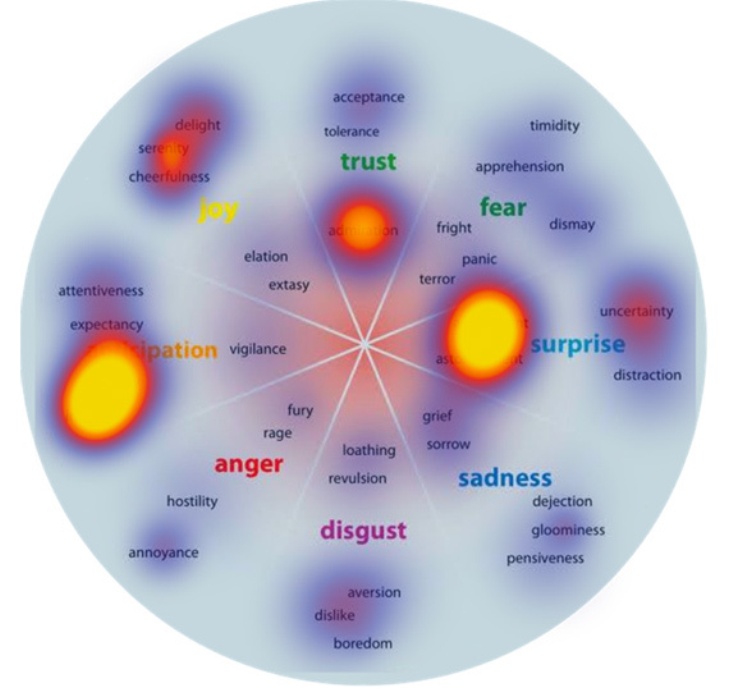
“When we care, we share,” or in other words, as Berger’s findings from his earlier paper show, people tend to share content that evokes a strong emotional reaction. Check out “You Tube’s 20 Most-Shared Adds of March” . Recent “Research the emotions that make marketing campaigns go viral” from Kelsey Libert and Kristin Tynski, published on the Harvard Business Review echoes the fact that high-energy emotions like curiosity, amazement, interest, astonishment, admiration are what truly stir discussion and are far more likely to be shared. See Plutchik’s Wheel of Emotion:
Practical Value
Great news for content marketers, practically useful material was shown to be highly viral. People like sharing “news you can use”, yet, when your content goes viral accept this fact: it is helping others advance their own platforms. Many people intentionally leverage the content messaging of others to advance their own personal brand and cause. For example, article titled “The Most Successful Leaders Do 15 Things Automatically, Every Day” by Glenn Llopis has exceeded 1.7 million views (and counting) and has sparked a tremendous amount of debate and repurposing. It has also been used as a featured article for at least one internal corporate publication across six different industries; a piece of the article was even used in the script of a popular reality television show.
Best way to make your content to go viral is to write a compelling title in the sample above. Your title is what attracts new viewers. The more people you can get to consume your content, the more chances you have for getting people to share it. If you can’t get the initial click, your content is dead in the water.
Humanize your content. People want to know that what is being written is real and not fabricated. Allow others to get to know who you are and what you stand for. Make your content relatable through thought-provoking storytelling that gives it personal depth and expresses your breadth of knowledge and wisdom.
Align your content narrative/messaging to the specific needs of your audience. To be viral content has to solve a problem, start a Trend. Always look through the lens of a problem solver and think five steps ahead. What problems await others that they might not expect? Be bold, stay on message with your content narrative, and be courageous enough to start a trend. The trick is in knowing what people find most interesting at the moment and leveraging that information. For example, when using a search engine, how many times have you clicked on the most interesting content instead of the content most relevant to your search?
When to go viral is the goal, make sure that you accomplish all of the following:
• Did you sufficiently cover the topic? Is it long enough?
• Does the content inspire a high-energy emotion like curiosity, amazement, interest?
• Did your tone convey emotion?
• Your content is practically useful?
• Is it interesting?
• Is it surprising?
• Does the author have fame/credibility?







Comments